The biggest M&A deals in India reveal a surprising pattern: the winners are not only companies with strong financial positions, but also those that focus on early diligence, governance scrutiny, and execution speed.
However, the vast majority of founders and initial investors do not research completed M&A transactions, including the infrastructure used, the risks avoided, and what almost led to them falling through.
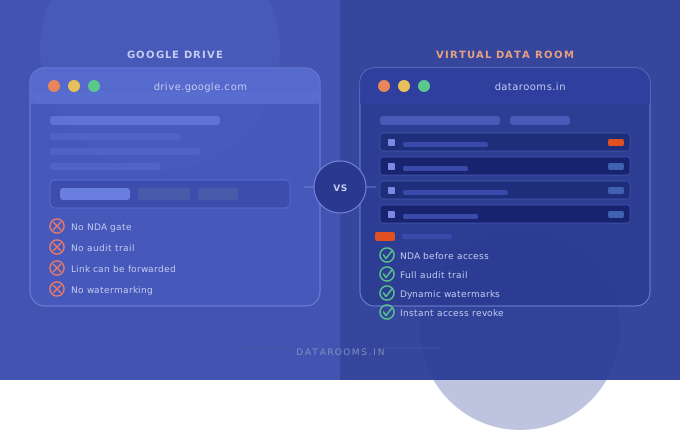
This blind spot is costly. As the M&A environment in India has become quite competitive, strategy alone is no longer the key driver of a successful deal. Execution discipline is important — many dealmakers now rely on a virtual data room solution to facilitate due diligence, disclosures, and authorized users’ coordination.
Pro Tip: Visit https://datarooms.in/virtual-data-room-for-ma/ to learn more about virtual data room for M&A.
India experienced a surge of historic acquisitions in the technology, financial services, energy, healthcare, and consumer sectors between 2023 and 2025. Behind these dealings were repeatable tendencies: clean data, structured disclosure, accelerated diligence cycles, and strict control of sensitive data — founders and investors can execute well before an exit is on the table.
This article studies the largest recent M&A transactions in India and discusses them to:
- Determine popular success patterns of closed transactions
- Derive useful insights for founders, investors, and deal makers
- Demonstrate how modern virtual data rooms facilitate faster, more secure deal processing
- Provide actionable frameworks you can apply in exits, fundraising, or strategic acquisitions
The Landmark Transactions Reshaping Indian Business
The period from 2023 to 2025 can be characterized by fewer, though larger and more structured, transactions in India. Scale, data control, and execution certainty were demanded mostly by strategic buyers and financial sponsors in regulated, technologically advanced industries.
Below are the deal categories that prevailed during this time:
1. Disney-Viacom18 / JioHotstar merger. Later in 2024 and early 2025, The Walt Disney Company and Reliance Industries merged Disney+ Hotstar with JioCinema and television assets into a combined entity often referred to as JioHotstar (forming a major media and streaming conglomerate valued at approximately US$8.5 billion). It was one of the biggest media industry acquisitions in India at that time and transformed the streaming market.
2. Emirates NBD acquires RBL Bank. In 2025, Emirates NBD bought a 60% stake in the Indian lender, worth about US$3 billion, and was among the biggest cross-border banking deals of the year.
3. Tata Motors buys Iveco Group. Tata Motors was involved in another strategic outbound M&A transaction that year, acquiring the operations of Iveco Group in Q3 2025, which cost approximately US$4.45 billion, and increased Tata’s global footprint in commercial vehicles.
4. ONGC NTPC Green buys Ayana Renewable Power. In 2025, the joint venture ONGC NTPC Green Private Limited reported the acquisition of Ayana Renewable Power — a large transaction in the Indian clean energy market, estimated at US$2.3 billion and focused on scaling renewable assets.
5. Bajaj Allianz (Bajaj Holdings) acquires Allianz stake. In 2025, Bajaj Holdings & Investment Ltd acquired Allianz SE’s stake in Bajaj Allianz General Insurance (a consolidation within Indian insurance) for approximately US$1.2 billion.
Common Success Pattern
The biggest deals, cross-border banking acquisitions and media mergers, were anchored in the professional virtual data room infrastructure to centralize due diligence files, legal confidential documents, regulatory disclosures, and stakeholder Q&A decks.
Even complex deals involving several regulatory and foreign parties were closed in 16-20 weeks, thanks to parallel diligence, automated reporting logs, advanced encryption, secure document sharing, and secure access to audited materials. Compliance is not the only way to document security as a momentum driver. Clean data packages lowered red flags and security risks in transactions.
Key insight: Proper due diligence documentation and the use of a secure online repository were decisive factors in the effective closing of complex transactions.
What Successful Indian M&A Deals Teach Us
India’s largest M&A transactions from 2023 to 2025 were not won by chance. They adhered to repeatable execution principles that founders, investors, and deal teams can follow long before a formal transaction starts.
Note: Learn more about Indian cross-border deals and the role of VDRs.
Lesson #1 – Due Diligence Infrastructure Matters
Winners saw due diligence as a process rather than an event. They had begun investing in structured virtual data room platforms to consolidate financials, legal documents, contracts, and operational data.
The result was instant buyer confidence. There were diligence phases when advisors and investors could review materials simultaneously, ask fewer questions to clarify, and make more progress.
Lesson learned: Organized documentation means faster deal closure and fewer last-minute surprises.
Lesson #2 – Transparency Builds Trust
Effective acquirers always preferred targets that exchanged information freely and consistently using professional virtual data room software. Transparency in the form of access privileges, full disclosures, and audit trail records minimized unpredictability in the negotiation process.
Such transparency paid off financially. Deals with transparent documentation were valued 15-20% higher because buyers perceived less execution and regulatory risk.
Lesson learned: Transparency is not a compromise — it is a valuable tool.
Lesson #3 – Compliance Documentation is Non-Negotiable
In fintech, healthtech, energy, and financial services transactions, fully documented regulatory reports were not a distinguishing factor; they were a minimum. Licenses, filing, approvals, and records of past compliance were supposed to be in place at the beginning.
Failure to comply fully was a red flag. In a few instances, it led to the extension of diligence, valuation haircuts, or stalled negotiations.
Lesson learned: Virtual data rooms offer systematic organization of compliance materials, with clear version control and regulator-ready documentation.
Lesson #4 – Speed Matters in Competitive Situations
Speed was an important determinant in auctions or multi-bidder processes. Buyers preferred sellers who could travel fast without affecting the diligence quality.
Businesses with established virtual data rooms prevailed. Structured sellers completed transactions 35-40 times quicker and, in many cases, won when the valuations were comparable.
Lesson learned: Preparation in competitive M&A builds momentum — and momentum closes the deal.
Why M&A Deals Fail
Not every deal breaks down due to price differences or strategic incompatibility. In the recent Indian M&A market, most deals collapsed due to predictable but avoidable operational reasons.
Failure Pattern #1 – Disorganized Documentation
Problem: Random documents in emails, shared drives, and personal folders create the buyer’s instant hesitation. Advisors waste time reconciling versions, and diligence teams question management’s readiness.
Solution: Implement a secure data room before approaching acquirers.
Impact: Sellers can eliminate 4-8 weeks of cumulative due diligence delays caused by lost files, re-uploads, and repeated clarification cycles.
Failure Pattern #2 – Missing Compliance Proof
Problem: Partial regulatory reports, such as licenses, applications, certifications, or past compliance reports, may bring a deal to a standstill, particularly in regulated business activities, including fintech, banking, or healthcare.
Solution: Use a virtual data room to exchange documents, manage sensitive files, and enable secure sharing with law firms, advisors, and other interested parties.
Example: Imagine a mid-sized Indian financial services acquisition collapsed late in diligence after the target failed to produce complete RBI compliance documentation, triggering buyer risk committees to withdraw.
Failure Pattern #3 – Poor Transparency
Problem: Any effort to conceal underperforming metrics, unresolved conflicts, or missing documentation is nearly always counterproductive. Delayed or selective disclosure is a red flag for governance by buyers.
Solution: A virtual data room provides controlled transparency, with role-based access control and audit history.
Insight: Buyers consistently place greater trust in sellers who are organized, documented, and upfront, even when challenges exist.
Failure Pattern #4 – Slow Response to Due Diligence Requests
Problem: Manual document gathering causes a 10-15-day delay per diligence request, which frustrates bidders and slows momentum, particularly in competitive processes.
Solution: A virtual data room will allow one to access pre-loaded materials and structured Q&A workflows in real time.
Data point: The organized sellers usually revert within 24 hours, and unprepared teams take up to two weeks, and the bidders always lose interest in the process.
The majority of unsuccessful M&A deals do not collapse on the strategy. They fail in preparation. In almost all situations, the lack of a structured virtual data room transforms bearable problems into deal-killers.
Essential Documentation Every Founder Should Prepare
Successful M&A deals are not ones that founders scramble to get documents after interest comes out. They create a full, well-organized documentation package and keep it within a virtual data room.
Financial Documentation
Customers begin diligence with financial understanding. Any such gaps instantly put the brakes on momentum or initiate valuation discounts.
Prepare the following:
- Cap table and shareholding structure
- Audited financial statements for the last three years
- Monthly profit and loss statements for the final 12 months
- Unit economics breakdown by product or customer segment
- Customer lifetime value (LTV) and acquisition cost analysis
Best practice: To ensure all sensitive documents can be reviewed as quickly as possible, organize them in a virtual data room with a clear folder structure and a naming convention.
Legal and Compliance
Legal preparation is not negotiable, especially for regulated or cross-border transactions. In this case, lost or stale records are among the common causes of deal delays.
Prepare:
- Incorporation and constitutional documents
- Intellectual property ownership and assignment proofs
- Employment and founder contracts
- Key partnership and vendor agreements
- Regulatory licenses and compliance certifications
Best practice: Store your legal and compliance documents in a virtual data room with advanced permissions, ensuring secure collaboration with law firms, investment banks, and private equity firms across multiple parties.
Operational Documentation
The growth story is supported by operational evidence and justifies the valuation assumptions. Buyers apply this material to understand scalability, execution risk, and team depth.
Prepare:
- Customer contracts, case studies, and references
- Product and service documentation
- Technical architecture and infrastructure overview
- Team organization chart and key employee resumes
- Centralized dashboard of core performance metrics
Best practice: Introduce operational documentation using a professional virtual data room system with a user-friendly interface, enabling fast document review, file sharing, and mobile access across multiple projects.
Getting Deal-Ready: Your 90-Day Roadmap
Becoming M&A-ready is a structured process, not a last-minute exercise. The following 90-day roadmap reflects how successful Indian founders prepared for acquisitions and competitive sale processes.
Step 1: Organize Documentation (Weeks 1–2)
Start with a full audit of what you already have.
Actions:
- Review all existing financial, legal, and operational documents
- Create a clear, buyer-friendly folder structure
- Identify missing, outdated, or inconsistent materials
- Apply a proven virtual data room template to standardize the organization
Step 2: Fill Compliance Gaps (Weeks 3–4)
Compliance issues are deal killers if discovered late.
Actions:
- Verify the status of all licenses and approvals
- Update intellectual property ownership and assignment records
- Prepare documented proof of regulatory compliance
- Centralize all compliance materials in a virtual data room
Step 3: Prepare Financial Data (Weeks 5–6)
This phase aligns your numbers with your narrative.
Actions:
- Clean up historical financial records
- Build a clear unit economics and profitability dashboard
- Prepare management presentations aligned with diligence data
- Enable real-time financial metrics inside the virtual data room
Step 4: Implement the Virtual Data Room (Weeks 7–8)
Now, formalize your deal infrastructure.
Actions:
- Select a secure, enterprise-grade virtual data room provider
- Upload all verified documentation
- Set role-based access permissions
- Enable audit trails and activity tracking.
Step 5: Brief Advisors & Prepare Q&A (Weeks 9–12)
Finalize readiness before buyer access.
Actions:
- Share virtual data room access with legal and financial advisors
- Pre-answer common diligence questions using the Q&A module
- Refine and update documents based on advisor feedback
- Confirm readiness for buyer and investor access
Founders who follow a structured 90-day preparation plan do not just reduce friction — they create momentum. A well-implemented virtual data room offers robust security, enhanced security, advanced security, and built-in collaboration tools to support board communications, advisor workflows, and secure interaction with interested parties throughout the deal lifecycle.
How to Use a Virtual Data Room Effectively in M&A
Dataroom effectiveness depends on how it is managed. In successful Indian M&A deals, founders treated the data room as a live execution tool — not a static file repository.
Organization Best Practices
Strong organization reduces friction and prevents unnecessary diligence cycles.
Follow these principles:
- Build a logical, buyer-friendly folder structure aligned with diligence workstreams
- Use clear, consistent document naming conventions
- Maintain strict version control to avoid confusion
- Update materials regularly to reflect the latest financial and operational data
Result: Faster reviews, fewer follow-up questions, and smoother diligence progression.
Access Management
Controlled access protects sensitive information while maintaining transparency and data room security.
Best practices include:
- Role-based permissions for buyers, legal advisors, and accountants
- Time-limited access for external stakeholders
- Continuous activity monitoring and reporting
- Document watermarking to prevent unauthorized distribution
Result: Secure disclosure without compromising deal momentum.
Investor Psychology
Buyers assess readiness before they assess numbers.
An effective virtual data room signals:
- Professional presentation equals operational maturity
- Organized documentation equals credibility
- Fast response times indicate a serious, deal-ready founder
- Complete records build trust across diligence teams
Insight: Well-managed virtual deal rooms influence perception long before valuation discussions conclude.
Red Flags to Avoid
Even strong businesses lose deals due to avoidable mistakes.
Common red flags include:
- Outdated or inconsistent documents
- Missing regulatory or compliance proof
- Disorganized or cluttered folder structures
- Slow or reactive responses to diligence requests
- Conflicting data across financial, legal, and operational files
In M&A, execution quality is visible. A disciplined, well-managed virtual data room does not just support the deal — it actively improves the outcome.
Inside the Investor’s Mind: What Buyers See in Your Virtual Data Room
Buyers do not evaluate companies linearly. They form judgments in phases, and your virtual data room directly shapes each one. Understanding this mindset helps founders anticipate concerns and remove friction before it appears.
First Impression (Hours 1–4)
The first few hours determine whether diligence moves forward or quietly stalls.
Buyers immediately assess:
- Overall document organization and folder logic
- Professional presentation and naming consistency
- Presence of core documents: financials, cap table, incorporation, and key contracts
In many processes, the first two hours decide whether a deal continues or loses momentum. A disorganized virtual data room often signals execution risk before numbers are even reviewed.
Initial Review (Days 1–5)
Once the deal clears the first filter, buyers shift to substance.
They focus on:
- Financial health and revenue quality
- Growth trajectory and sustainability
- Customer quality and concentration risk
- Management team credibility and depth
This is a critical window where virtual data room structure matters most. Clear labeling, logical sequencing, and fast access prevent misinterpretation and unnecessary follow-up questions.
Deep Dive Phase (Weeks 2–4)
Serious diligence begins here, often involving multiple internal and external teams.
Buyers examine:
- Regulatory compliance history
- Intellectual property ownership and protection
- Customer concentration and contract durability
- Unit economics and margin drivers
An organized virtual data room can cut deep-dive review time by up to 40%, allowing buyers to maintain deal urgency and reduce internal friction.
Decision Phase (Weeks 5–8)
At this stage, most technical risks are resolved. Execution becomes the differentiator.
Buyers focus on:
- Final clarification questions
- Valuation negotiations and assumptions
- Deal structure and key terms
- Closing and transition documentation
Speed becomes a competitive advantage. Organized sellers with a well-managed virtual data room close faster, face fewer last-minute objections, and retain leverage during final negotiations.
Buyers do not just read your data — they interpret your readiness. A disciplined virtual data room guides them smoothly from interest to conviction to close.
Choosing the Right Virtual Data Room for M&A
Not all virtual data rooms are designed for M&A. A data room for due diligence impacts its speed, buyer trust, and overall control of the deals.
Pro Tip: Compare VDR pricing to choose the most cost-effective solution.
Critical Features for M&A Success
When choosing the best virtual data room in India, prioritize features that facilitate speed, security, and information disclosure. They include:
- Role access control to deal with buyers, legal advisors, and financial teams individually
- Real-time activity tracking to know what documents investors look at
- Watermarking and high-level security measures to ensure sensitive information security
- Built-in Q&A section to streamline and normalize buyer queries
- Professional presentation, which indicates institutional-grade governance
These features make the data room more than a file repository.
Red Flags
The following limitations can affect even robust transactions:
- Limited or weak security controls
- Poor or confusing user interface
- No document-level or user-level activity tracking
- High pricing without M&A-specific functionality
- Slow or unresponsive customer support
For live deals, weak platforms cause friction, retards the due diligence process, and frustrate buyers.
Pro tip: Compare virtual data room providers at https://startupdatarooms.com/.
The Takeaway: M&A Success Starts with Preparation
The most successful M&A transactions in India from 2023 to 2025 have one common feature: they are based on a well-established virtual data room infrastructure; it is not a last-minute rush to collect the necessary documents.
For founders, the message is simple. Preparation should start before an exit conversation begins. An organized 90-day deal-readiness map will transform documentation, compliance, and reporting into assets and not liabilities.
To investors and acquirers, properly structured sellers have a strong message. Transparency, clean data rooms, and timely responses are signs of operational maturity, reduced execution risk, and greater governance.
Successful M&A is hardly by chance. This is the outcome of due diligence preparation, disciplined implementation, and professional documentation, brought together in a well-managed virtual data room.