Raising capital has become one of the most demanding phases in the life of an Indian startup. Beyond a compelling pitch and a strong product, founders must now demonstrate a level of transparency, accuracy, and compliance that inspires confidence among investors. Due diligence has grown more sophisticated in India, and the expectations around documentation have become stricter. In this environment, Virtual Data Rooms (VDRs) have quietly moved from being a “nice extra” to becoming an essential tool that shapes how deals are evaluated and eventually closed.
Where startups use a VDR during due diligence (quick map):
- Preparing documents early before the first investor request (folders, indexing, version control)
- Controlling access with role-based permissions and restricted areas
- Tracking investor engagement with activity logs and document-level analytics
- Managing Q&A and updates without messy email threads
- Keeping a post-deal archive ready for the next round
If you’re still mapping the basics, start here: https://datarooms.in/
In recent years, Indian founders have started using VDRs not simply as secure storage systems, but as strategic engines that help accelerate the due diligence process, improve investor communication, and present their companies as organised, compliant, and investment-ready. This article explores how exactly Indian startups use VDRs during due diligence — from early preparation to investor access — and why these tools now play such an important role in fundraising in India.
Why Due Diligence Has Become More Demanding in India
The Indian investment landscape has changed dramatically. Several factors have contributed to this shift: the Digital Personal Data Protection (DPDP) framework, tighter expectations around incident readiness, increased overseas funding into Indian companies, and more detailed checks around taxation, cybersecurity, and governance. If you want the source texts investors and counsel often reference, see the DPDP Act on India Code and the CERT-In Directions (2022).
Investors want much more than a simple collection of documents. They want consistency, verification, traceability, and an assurance that a startup is running its operations in a way that stands up to scrutiny.
Founders often discover that even promising deals are delayed not because investors lost interest, but because the documentation was scattered, incomplete, or difficult to verify. A VDR changes that dynamic by making the due diligence workflow cleaner, more transparent, and easier to manage.
Preparing the Startup Before Due Diligence Begins
Indian startups typically begin using a virtual data room weeks before they even invite an investor inside. This preparation phase is crucial. It allows the founding team to bring together all the documents that will eventually be requested during due diligence, but in a calm, organised manner rather than in a stressful, last-minute rush.
Most startups begin by setting up a clear structure inside the VDR. The logic is simple: corporate documents go into one place, financial materials into another, contracts and agreements into their own space, and so on. This creates a clean digital environment where everything is intuitively located. Instead of juggling folders across personal Google Drives, WhatsApp messages, or email chains, the entire company works inside one shared, controlled system.
Typical due diligence sections Indian startups organise inside a VDR:
- Corporate & statutory (incorporation docs, MCA filings, cap table)
- Finance & tax (financials, GST/TDS, audits, projections)
- Commercial (customer contracts, vendor agreements, key policies)
- People (employment docs, ESOP plan, key hires)
- Product & IP (IP assignments, patents/trademarks, architecture notes)
- Compliance & security (DPDP readiness, security policies, incident logs)
An unexpected benefit of this early preparation is that founders often uncover gaps in their documentation. Perhaps a contract was never signed properly, a compliance certificate was not renewed, or an important filing is missing. Finding these issues early — and quietly resolving them before an investor notices — becomes a real advantage once diligence starts.
This is exactly where a data room due diligence workflow pays off: you can validate files category by category, track what’s missing, and standardise naming and version history before anyone external reviews it. Instead of reacting to investor requests, you control the pace and reduce last-minute surprises.
Bringing All Documents Together in One Controlled System
Once the basic structure is in place, startups begin uploading their documents. This varies depending on the maturity of the company. Earlier-stage teams may only have a limited set of contracts and basic financial statements. In contrast, Series B or C companies often upload hundreds of files covering everything from employee agreements to product architecture descriptions.
What makes the VDR valuable here is its ability to act as the “single source of truth.” Indian startups often work with multiple partners — chartered accountants, company secretaries, external legal advisors, HR consultants — and each may store documents in different places. A VDR reduces fragmentation. Everyone responsible for documentation contributes to a system that stays consistent, current, and version-controlled.
This may sound like a simple operational improvement, but in Indian fundraising, it changes the day-to-day experience. Investors frequently complain that startups provide documents from different periods, outdated versions, or inconsistent formats. With a VDR, documents become easier to standardise, trace, and timestamp.
For official corporate context and company-services access points, the Ministry of Corporate Affairs (MCA) website is the primary reference.
Granting Access to Investors and Setting the Right Permissions
When the data room is finally ready, founders begin giving investors access. This is where VDRs prove their strategic value.
Every investor enters the data room with different responsibilities. Analysts often need only read-only access. Legal teams may need to download files. Partners might require deeper access to confidential folders. Some information, particularly related to intellectual property or HR, must be restricted to a very small group of people.
Permission setup that keeps founders in control:
- Give analysts view-only access for most folders
- Allow legal teams limited downloads (only where required)
- Restrict HR/IP folders to a small, named group
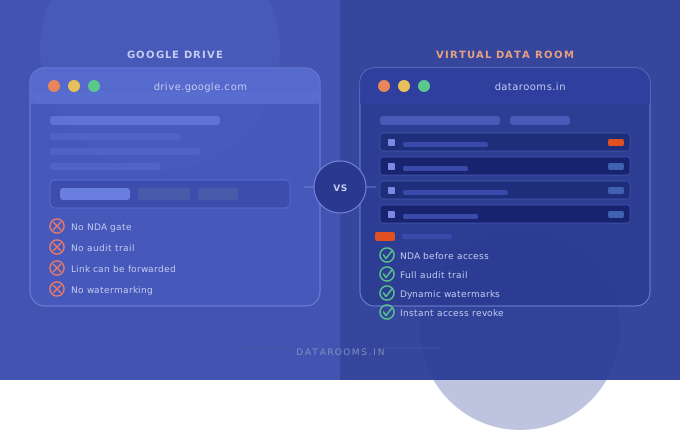
- Apply dynamic watermarking on sensitive documents
- Use expiry dates for access during time-boxed reviews
- Keep audit trails on every view, download, and permission change
A virtual data room allows founders to create this multi-layered access environment without chaos. The system enforces role-based permissions, protects files with watermarks, can disable screenshots if needed, and tracks actions taken inside the platform. For Indian startups, this matters because proprietary tech, customer information, and employee data must be shared selectively and responsibly.
This permission structure reassures investors as well. It signals that the startup takes confidentiality seriously — a factor that becomes even more important when overseas investors operate under strict internal compliance frameworks.
Understanding Investor Behaviour Through Analytics
One of the most underestimated advantages of a VDR is the visibility it gives founders into investor engagement. Unlike email attachments or basic cloud links, a data room records how much time an investor spends inside, which documents they view, and which sections attract the most attention.
These analytics can reveal the real temperature of a deal. If a partner at a fund spends time reviewing financial statements and commercial agreements, interest is usually strong. If the legal team keeps returning to specific compliance folders, it may signal where questions will land next.
Founders across India often use this visibility to prepare for follow-up calls, anticipate concerns, and address potential red flags earlier.
Reducing Bottlenecks and Eliminating Back-and-Forth Communication
Anyone who has gone through an Indian due diligence process knows how much time is usually wasted answering the same questions, sending new versions of files, or correcting miscommunications. A VDR reduces a lot of that back-and-forth.
Because everything sits in one centralised, updated system, investors can access the data room whenever they need something. If founders update a document, the version changes without breaking links. If an investor asks a question, the answer can be logged cleanly and tied back to the relevant file.
Instead of endless email threads and scattered attachments, the diligence conversation stays more organised. Many founders find that once the VDR is structured well, investors ask fewer repetitive questions because information is easier to verify.
Building Investor Confidence and Professionalism
Although VDRs are technical tools, the impact they create is also behavioural. Investors gain confidence when they see a well-structured, organised data room. It signals discipline, operational clarity, and readiness — qualities that influence how smoothly a deal progresses.
For global investors in particular, a VDR aligns the startup with familiar due diligence expectations. For Indian funds, it reduces the risk of surprises and lowers the friction that slows down evaluation.
Handling Foreign Investment Scenarios More Smoothly
India continues to attract foreign capital, but cross-border investment often introduces additional complexity. When overseas investors are involved, legal teams may reference FEMA-related requirements and supporting filings as part of their diligence. For founders who want the official baseline, see the Foreign Exchange Management Act (FEMA) text on India Code.
A VDR helps in these scenarios by providing a controlled, auditable place to share approvals, valuation reports, and regulatory documentation. It also reduces timezone friction: international teams can review materials asynchronously without constant document chasing.
Creating a Smooth Close and Post-Deal Document History
A VDR continues to be useful even after a deal closes. Many Indian startups keep it as an archive for signed agreements, board consents, and compliance records. This becomes valuable during subsequent funding rounds because the startup doesn’t have to rebuild documentation from scratch.
Founders simply update the same structure with new agreements, financials, and certifications, maintaining a clean document history over time.
What to compare before choosing a VDR (startup checklist):
- Permission depth (roles, folder-level rules, link controls)
- Audit trail quality (exportable logs, detail level, retention)
- Q&A workflow (moderation, threads, attachments, ownership)
- Security controls (watermarks, MFA/SSO, IP restrictions)
- Ease of setup (templates, bulk upload, indexing)
- Reporting & analytics (engagement, document heat, user activity)
- Support readiness (24/7 coverage during live diligence)
- Pricing model fit (per-user vs per-project vs storage-based)
Why VDRs Are Becoming Essential for Indian Startups
The rise of VDR usage among Indian startups is a response to the realities of India’s compliance environment and the pressure of a competitive fundraising market. Due diligence requires accuracy, consistency, and transparency. Virtual data rooms help founders deliver that in a way investors can verify.
They simplify document preparation, support a clean structure, reassure investors through access controls, provide visibility into engagement, and reduce the friction that slows down deal evaluation.
For Indian startups that want to scale quickly, attract high-quality investors, and run diligence with fewer surprises, a VDR has become a practical foundation for modern fundraising.